English
 русский
 Français
 Español
 Indonesia
 Deutsch
 عربى
عربى 中文简体
中文简体


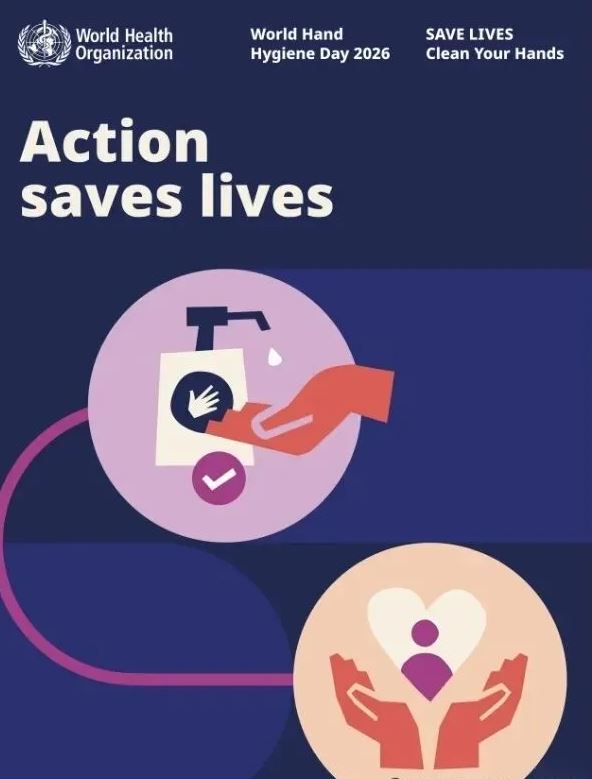
2026 SAVE LIVES: Clean Your Hands slogan - Action saves lives.
Posted by Admin | 07 May
Content
- 1 World Hand Hygiene Day 2026: Action Saves Lives
- 2 HAIs: The Invisible Crisis Inside Healthcare Facilities
- 3 The Often-Overlooked Foundation: WASH and the Equity Dimension
- 4 The WHO "My 5 Moments for Hand Hygiene": Getting It Right, Not Just Getting It Done
- 5 From Awareness to Accountability: What the IPC Global Action Plan Requires
- 6 Why This Moment Demands More Than Awareness
World Hand Hygiene Day 2026: Action Saves Lives
Every year on May 5th, World Hand Hygiene Day sends a collective wake-up call to healthcare systems around the world. In 2026, that call carries more urgency than ever before. The theme — "Action saves lives" — is not a slogan. It is a demand rooted in data, driven by the daily reality of preventable harm.
Healthcare-associated infections (HAIs) quietly erode healthcare systems every single day. They occur in wards, operating rooms, and intensive care units — in every moment an inadequately cleaned pair of hands makes contact with a patient. They cause premature deaths, permanent disability, and surging healthcare costs. And they are a major accelerant of one of the most dangerous threats in modern medicine: antimicrobial resistance (AMR).
HAIs: The Invisible Crisis Inside Healthcare Facilities
HAIs do not discriminate by hospital tier or national income level. They emerge in well-resourced tertiary centers and under-equipped primary health posts alike. They occur during routine care and during public health emergencies. In every setting, across every context, they pose a daily threat to patient safety.
The burden is multilayered. For individual patients, HAIs mean worsening conditions, extended hospital stays, and in too many cases, lives cut short. For families, they bring financial hardship and lasting emotional trauma. For healthcare workers, sustained exposure to infection risk creates a serious occupational burden that is rarely acknowledged. At the system level, HAIs consume resources that could otherwise be directed toward improving quality of care — and they stand in direct opposition to the global goal of delivering equitable, high-quality healthcare for all.
The link between HAIs and AMR makes this doubly urgent. More infections drive greater antibiotic use; greater antibiotic use accelerates the emergence of drug-resistant organisms. It is a dangerous cycle — and one of the most effective points of intervention is also among the simplest: hand hygiene.
The Often-Overlooked Foundation: WASH and the Equity Dimension
Discussions about hand hygiene often focus on technique and compliance, while a more fundamental question goes unanswered: are the physical conditions for handwashing even available?
WHO has made clear that best practices in hand hygiene and infection prevention are directly shaped by the built environment. In many facilities, the absence of reliable water access, functional sanitation infrastructure, proper waste management systems, and adequate hygiene conditions — collectively known as WASH — renders hand hygiene guidelines effectively unenforceable. These gaps do not just limit practice; they create inequities in dignity and safety for both those delivering and those receiving care.
Promoting hand hygiene without addressing WASH infrastructure is an incomplete strategy. Guidelines printed on paper mean little when there is no functioning sink nearby.
The WHO "My 5 Moments for Hand Hygiene": Getting It Right, Not Just Getting It Done
One of the central goals of World Hand Hygiene Day 2026 is to embed best-practice hand hygiene into clinical workflows — not as a periodic reminder, but as a standard, non-negotiable part of how care is delivered. This means both performing hand hygiene and performing it correctly, guided by WHO's established framework: My 5 Moments for Hand Hygiene.
The five moments define precisely when healthcare workers must perform hand hygiene: before touching a patient, before a clean or aseptic procedure, after body fluid exposure risk, after touching a patient, and after touching patient surroundings. These are not suggestions. They are evidence-based standards that have been validated across decades of research and real-world implementation.
The focus for 2026 is on genuine integration — moving the five moments from training materials into the actual rhythm of clinical practice, where compliance can be observed, measured, and improved.
From Awareness to Accountability: What the IPC Global Action Plan Requires
WHO's Global Action Plan and Monitoring Framework for Infection Prevention and Control 2024–2030 provides member states with a structured, time-bound roadmap. World Hand Hygiene Day 2026 draws directly from this framework to define three levels of required action.
Policy integration. Hand hygiene must not exist as a standalone health promotion initiative. It needs to be embedded as a core strategy within national IPC action plans and translated into specific, actionable standard operating procedures (SOPs) at the facility level. The chain from national policy to frontline practice must be clear, traceable, and operational.
Monitoring and feedback. Member states are called upon to establish hand hygiene compliance monitoring and feedback as a core national health system performance indicator. Monitoring alone does not drive improvement — feedback does. WHO's timeline is explicit: by the end of 2026 at the latest, all national exemplar hospitals must have fully functional monitoring and feedback systems in place. This is a measurable commitment with a defined deadline.
Comprehensive action. Beyond individual measures, the international community is urging countries to act decisively across the full IPC spectrum. Hand hygiene is the entry point; raising the overall standard of infection prevention and control begins here.
Why This Moment Demands More Than Awareness
In 2026, the global health system faces compounding pressures: AMR is escalating, the capacity to respond to public health emergencies varies enormously across settings, and inequities in healthcare access remain deeply entrenched. Against this backdrop, IPC measures — and hand hygiene in particular — carry greater strategic importance than at any previous point.
Hand hygiene is the lowest-cost, most broadly accessible, and most reliably effective infection control intervention available. A single correct, timely hand hygiene action can break a chain of pathogen transmission. Millions of such actions, consistently performed across healthcare systems, have the power to reshape the landscape of hospital-acquired infection.
That is the weight behind "Action saves lives." Not the theme as a phrase, but the theme as a directive. World Hand Hygiene Day provides a global focal point — but the work that matters happens in the days and months that follow, in clinics and wards and operating rooms, in every encounter between a healthcare worker and a patient where the right action is taken at the right moment.