English
 русский
 Français
 Español
 Indonesia
 Deutsch
 عربى
عربى 中文简体
中文简体
Autoclave in the Pharmaceutical Industry: Principles, Types, Validation
Posted by Admin | 11 Sep
Content
- 1 What an Autoclave Is and Why Pharma Depends on It
- 2 The Autoclave Cycle, Step by Step
- 3 Types of Autoclaves Used in Pharmaceutical Facilities
- 4 Where Autoclaves Sit in the Pharmaceutical Workflow
- 5 Validation and Monitoring: Proving the Cycle Works
- 6 Common Problems and How to Prevent Them
- 7 Choosing the Right Autoclave for Your Facility
- 8 Working With a Manufacturer Who Understands Pharma
In pharmaceutical manufacturing, sterility is never something taken on faith. Every batch of injectable product, every sterile component, and every reusable piece of process equipment carries a documented history of how it was cleaned, treated, and released. The autoclave sits at the centre of that history. By applying saturated steam under pressure, an autoclave destroys microorganisms on glassware, stainless steel parts, filter housings, tubing, garments, culture media, and, in purpose-built units, sealed liquid containers as well.
For the people responsible for sterility assurance, the practical questions rarely change: does the cycle really reach the whole load, can it be reproduced batch after batch, and can it be defended in front of an auditor? The sections below cover the working principle, the cycle stages, the equipment configurations that matter in production, and the validation and maintenance habits that separate a dependable sterilizer from a permanent source of deviations.
What an Autoclave Is and Why Pharma Depends on It
An autoclave is a pressure vessel built to expose a load to saturated steam at a defined temperature for a defined time. Moist heat kills microorganisms by denaturing their proteins and nucleic acids. When saturated steam meets a cooler surface, it condenses and releases latent heat, transferring energy far more efficiently than hot air ever could. That is why a steam cycle can achieve sterility at 121 °C in fifteen to thirty minutes, while dry heat frequently needs 160 °C for two hours or more.
Pressure plays a supporting role rather than the leading one. Raising chamber pressure raises the boiling point of water so that saturated steam can exist at 121 °C or 134 °C. The pressure itself is not the sterilizing agent; the moist heat is. Steam also penetrates porous loads well, which is exactly what wrapped instrument trays, filter housings, tubing assemblies, and textile packs require.
The price of that efficiency is that steam is unforgiving about air. A pocket of air trapped inside a wrapped pack, a narrow lumen, or a densely loaded chamber acts as an insulator and creates a cold spot where the target temperature is never reached. Almost every design feature of a modern pharmaceutical autoclave, from vacuum pumps and pulsed pre-vacuum to steam traps and air detectors, exists to remove air and keep it out.
The Autoclave Cycle, Step by Step
Although chamber sizes and control systems differ, a well-designed steam sterilization cycle follows the same logic from start to finish:
- Loading and preparation. Items are cleaned, wrapped or placed in containers, and arranged so that steam can circulate freely. Overloading or blocking the drain line is one of the most common causes of failed cycles.
- Air removal. Gravity displacement lets steam push air down and out through the drain, while pre-vacuum cycles use repeated vacuum and steam pulses to strip air from porous and wrapped loads.
- Steam injection and heat-up. Saturated steam fills the chamber until the load itself, not just the chamber atmosphere, reaches the set temperature.
- Exposure or holding phase. The load is held at temperature, typically 121 °C for 15 to 30 minutes or 134 °C for 3 to 4 minutes, depending on the validated cycle. In liquid sterilization, accumulated lethality, often expressed as F0, becomes the decisive parameter.
- Exhaust and pressure equalisation. Steam is removed slowly. Sealed liquid containers require controlled cooling and counter-pressure to prevent breakage or deformation.
- Drying and cooling. Residual condensate is drawn off so that packs are dry when the door opens, which protects the sterile barrier.
- Release. Chemical indicators, biological indicators, and recorded cycle data are reviewed before the load is released to production.
Types of Autoclaves Used in Pharmaceutical Facilities
Choosing a configuration is really a question of what has to be removed from the load and how the load behaves under heat and pressure.
| Configuration | Air removal method | Typical pharmaceutical use |
|---|---|---|
| Gravity displacement | Steam displaces air downward through the drain | Simple, robust sterilization of instruments, glassware, and non-porous items |
| Pre-vacuum (pulse vacuum) | Repeated vacuum and steam pulses | Wrapped trays, filters, tubing, and validated porous production loads |
| Steam-air mixture | Steam blended with compressed air | Sealed containers and flexible packaging that must not deform |
| Water bath or immersion | Load fully submerged in heated water | Sealed ampoules, vials, and liquid-filled containers |
| Pass-through (double door) | Same as the base cycle type | Barrier between non-classified and aseptic zones in sterile facilities |
| Table-top Class B | Fractionated vacuum | Small-scale laboratory and quality control work |
Most plants combine two or three of these. Gravity units remain economical for simple loads, while pre-vacuum horizontal sterilizers carry the validated porous loads that feed aseptic processing, and water bath units take care of sealed liquid containers.
Where Autoclaves Sit in the Pharmaceutical Workflow
Equipment, components, and change parts
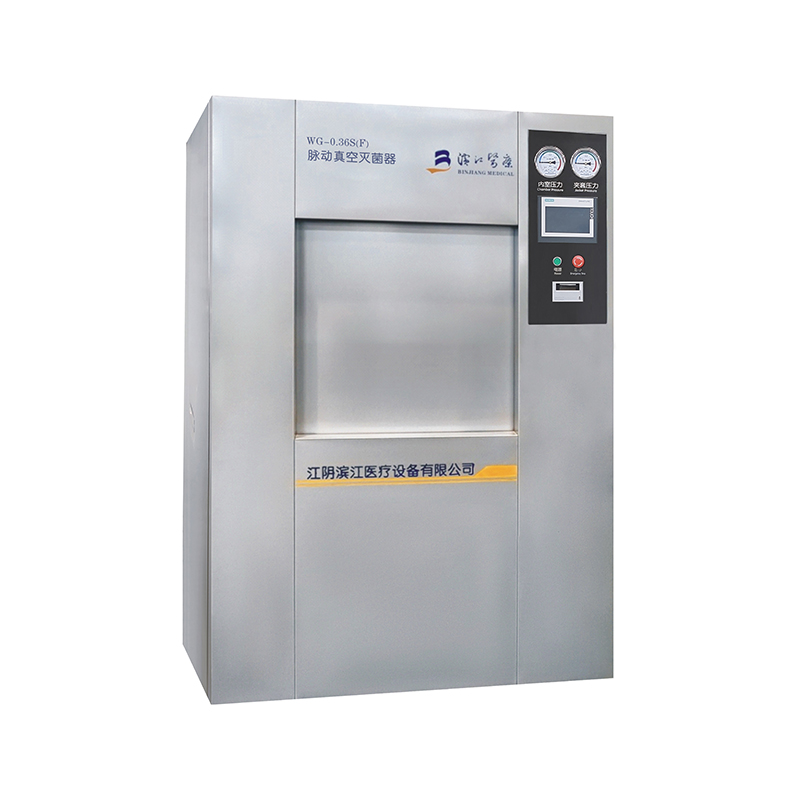
Filling needles, filter housings, tubing assemblies, stopper bowls, and hand tools all have to be sterile before they touch product. These loads are porous, wrapped, and often awkwardly shaped, which is why pulsed pre-vacuum cycles are the standard choice. A pulse vacuum chamber with programmable recipes and cycle documentation gives production teams repeatable conditions and an auditable record for each batch.
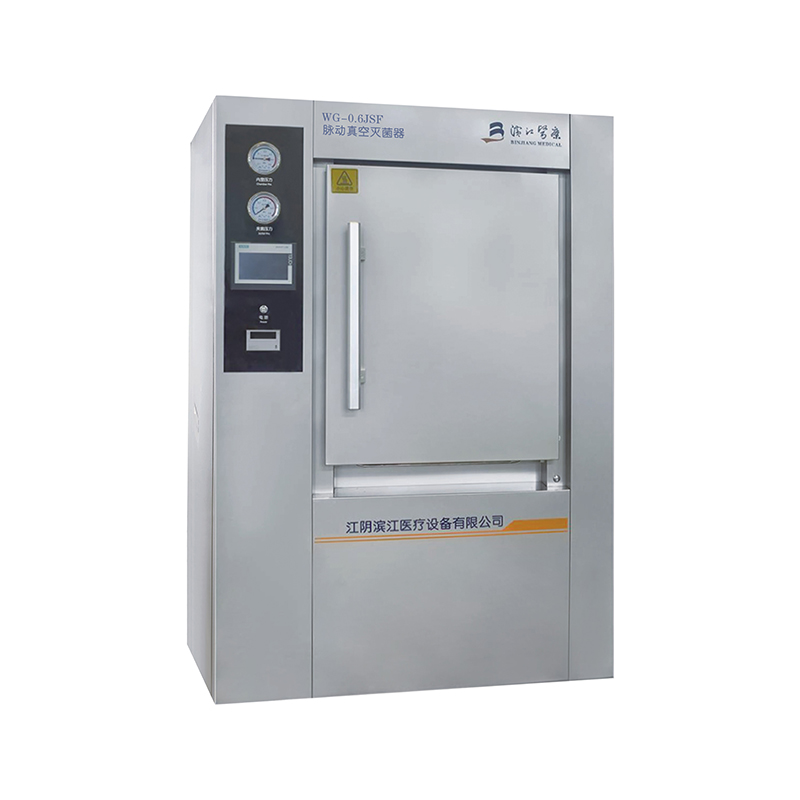 WG Pulse Vacuum AutoclaveWG series pulsating vacuum sterilizers use saturated steam as the sterilizing medium, by relying on the physical property that the saturated steam can release a large ...View Product →
Media, glassware, and laboratory support
Microbiology and quality control laboratories sterilize culture media, glassware, sampling tools, and waste. The volumes are smaller, but the requirements for documented cycles and reliable temperature distribution are just as strict, and table-top or vertical units usually match that scale well.
Ampoules, vials, and liquid products
Terminal sterilization of sealed liquid containers calls for water bath or immersion sterilizers, where the load is submerged in heated water and counter-pressure protects the container. Water bath sterilizers are widely used for ampoules and similar presentations because heat transfer is uniform and the risk of container deformation is controlled.
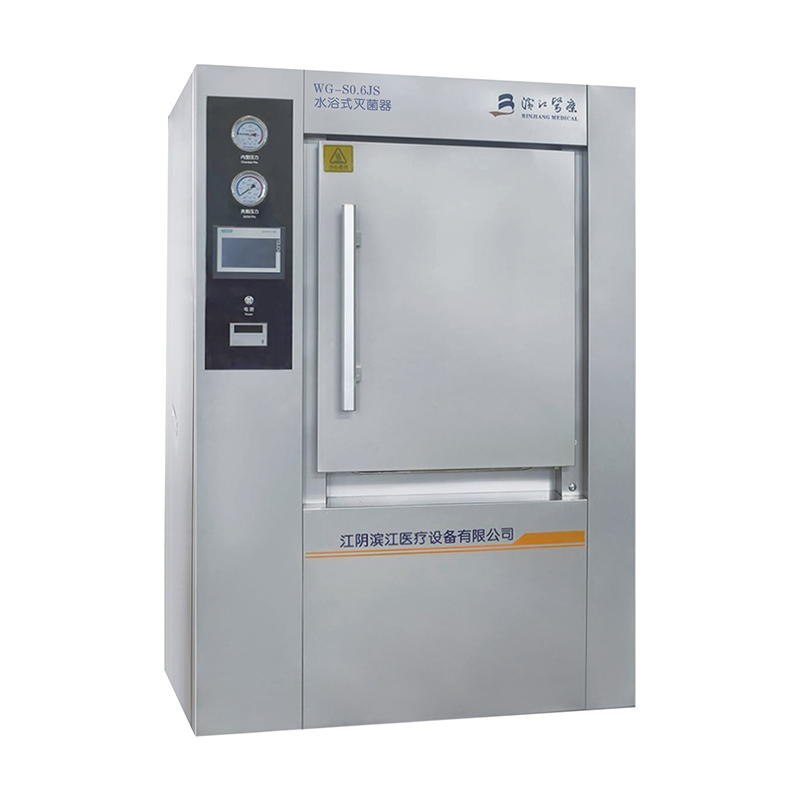 WG-S0.6JS Water Bath SterilizerThe series of water bath sterilizers utilize high-temperature circulating water as the sterilization medium. The items undergo a process of spray heating, sterilizatio...View Product →
After sterilization, ampoule integrity still has to be confirmed. Leak testing equipment identifies containers with micro-cracks or incomplete seals, so that defective units never reach the filling or packaging stage.
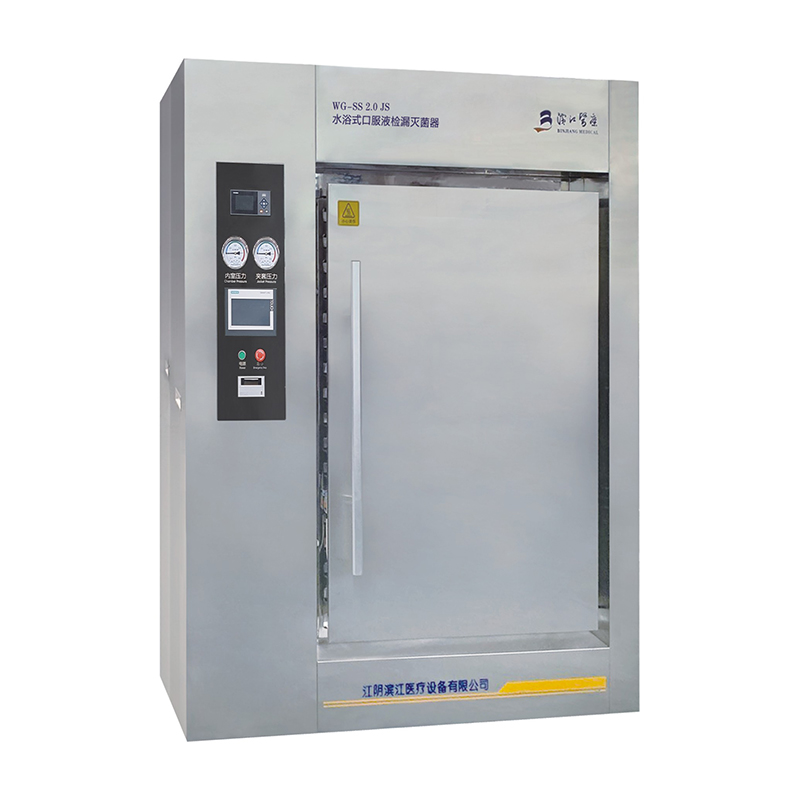 WG-SS2.0JS Ampoule Leak Testing Water Bath SterilizerThese sterilizers use high-temperature deionized water as the sterilization medium. The deionized water circulates internally and uniformly sprays onto the sterilized ...View Product →
Cleanroom and aseptic support
Where clean and aseptic areas are physically separated, pass-through sterilizers allow a load to enter the sterile side without breaking the barrier. Combined with controlled loading, garment handling, and environmental monitoring, they form part of the contamination control strategy rather than an isolated piece of equipment.
Validation and Monitoring: Proving the Cycle Works
A sterilizer is only as good as the evidence behind it. A typical pharmaceutical validation package covers installation and operational qualification, load mapping with independent temperature and pressure measurement, and performance qualification using worst-case loads. Routine monitoring then keeps the cycle honest:
- Physical records. Temperature, pressure, and time data are logged for every cycle, with independent probes used during validation to confirm that the control sensors are accurate.
- Chemical indicators. External and internal indicators give an immediate visual check that the load has been exposed to sterilizing conditions.
- Biological indicators. Spore preparations of Geobacillus stearothermophilus are the recognised challenge for steam cycles, and incubation results support load release policy.
- Air removal testing. The Bowie-Dick style air removal test remains the fastest way to detect a vacuum system that is no longer pulling air out of porous loads, and it should be part of routine monitoring, not just commissioning.
- Leak testing. A rising chamber pressure during the vacuum hold points to a door gasket, valve, or piping leak that will eventually compromise air removal.
- Periodic requalification. Cycles should be revalidated after major repairs, control changes, or load modifications, in line with the facility's change control procedure.
Common Problems and How to Prevent Them
Most autoclave deviations trace back to a handful of root causes, and each one has a practical countermeasure:
- Wet loads. Usually caused by poor steam quality, blocked drains, or an insufficient drying phase. Checking the steam supply, cleaning strainers, and reviewing the drying stage solve most cases.
- Cold spots and failed air removal. Often a loading problem. Repositioning packs, avoiding contact with the chamber wall, and using a validated load pattern restore consistent results.
- Vacuum leaks. Typically worn door gaskets, valve seats, or fittings. A scheduled leak test catches them before a batch is lost.
- Poor steam quality. Wet, superheated, or contaminated steam changes the heat transfer behaviour of the whole cycle, which is why steam quality is specified and monitored rather than assumed.
- Scale and water quality. Hard water leaves deposits on jackets, pipes, and chamber surfaces. Treated feed water and regular descaling protect both performance and service life.
Choosing the Right Autoclave for Your Facility
- Start with the load. List every item that will be sterilized, including the hardest one. The most demanding item, not the average one, defines the required cycle.
- Size the chamber around the load, not the room. A chamber that is too large wastes steam and cycle time; one that is too small invites overloading and failed air removal.
- Match air removal to the application. Porous and wrapped loads need pre-vacuum capability, and sealed liquids need water immersion or counter-pressure cycles.
- Plan the utilities early. Steam quality, water supply, compressed air, drain capacity, electrical load, and door clearances all influence installation cost and uptime.
- Look at controls and data handling. Recipe management, audit trails, printed cycle records, and alarm histories make day-to-day operation and inspection easier.
- Check construction and serviceability. Chamber material, welding quality, gasket accessibility, and the availability of spare parts matter over a fifteen-year service life.
- Confirm validation and service support. A supplier who understands qualification documentation, calibration, and preventive maintenance is worth more than a lower purchase price.
Working With a Manufacturer Who Understands Pharma
JIBIMED has been building sterilization equipment since 1997, with two production areas covering 40 acres and more than 30,000 square metres of manufacturing space. Across more than ten production lines, the company produces pressure steam sterilizers in horizontal, vertical, table-top, and portable formats, along with pulse vacuum systems, water bath sterilizers, ampoule leak testing units, low-temperature plasma sterilizers, and supporting equipment such as ultrasonic cleaners, drying ovens, and distilled water units. Annual capacity reaches around 50,000 units, and products are exported to more than fifty countries.
That experience is useful precisely because pharmaceutical sterilization is a system, not a box. The chamber, the steam supply, the load pattern, the monitoring programme, and the validation documentation all have to work together. If you are specifying a new unit, replacing an ageing chamber, or reviewing a cycle that no longer behaves the way it used to, the most efficient first step is a conversation about the load and the required outcome, and the equipment specification follows from there.